Dodleston Parish Council and Kings Moat -
structure, finances and what it means for Kings Moat
Kings Moat forms part of Dodleston Civil Parish, meaning residents pay a Dodleston Parish Council precept as part of their annual Council Tax.
Parish councils are the first tier of local government. They are separate from Cheshire West and Chester Council and have limited legal powers to provide or support local services and represent community interests. Their responsibilities can include community facilities, public open spaces, small grants, local projects and commenting on planning applications. They cannot provide major services such as highways, education, waste collection or social care, which remain the responsibility of Cheshire West and Chester Council.
How the Parish Council is Funded
The Parish Council’s main source of income is the parish precept, which is collected through Council Tax from properties within the parish.
Each year Dodleston Parish Council:
- prepares a budget for the coming financial year
- decides how much money is required
- sets a parish precept
- publishes its annual accounts and is subject to internal and external audit
Parish councils are required to account for how public money is spent and publish financial information for residents to inspect.
Growing Importance of Kings Moat
Kings Moat is now the largest residential area within Dodleston Parish and continues to grow. As more homes are occupied, Kings Moat residents contribute an increasing proportion of the Parish Council’s income through the parish precept.
This growth means decisions made by Dodleston Parish Council have an increasing impact on Kings Moat residents, both financially and in terms of how parish resources are allocated.
Representation and Decision-Making
Dodleston Parish Council is responsible for representing the whole parish, including Dodleston village and Kings Moat. Parish councilors are elected to represent the whole parish and represent the whole parish regardless of where they live. Based on publicly available information, the current Parish Council appears to comprise councilors from the long-established parish communities, with no publicly identifiable councilor currently residing on Kings Moat.
As Kings Moat continues to grow, residents have shown increasing interest in understanding:
- how parish funds are allocated
- which projects benefit Kings Moat
- how decisions are made
- how they can engage with the Parish Council
Parish Council meetings are generally open to the public, with agendas, minutes and financial documents published to help residents understand how decisions are made and how public funds are used.
As Kings Moat approaches completion, it is expected to become the largest community within Dodleston Parish. This makes effective communication, transparency and resident engagement increasingly important so that the views and needs of both existing and future residents are properly understood and considered when parish decisions are made.
Dodleston Parish Council - Financial position between 2019 and 2026
As Kings Moat has grown, so has the number of households within Dodleston Parish, bringing significant changes to the Parish Council's finances.
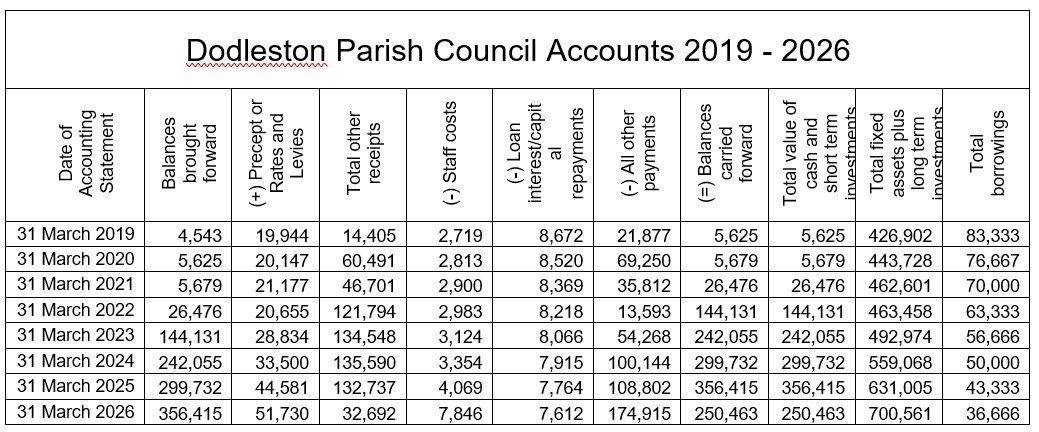
This section summarises information from the Parish Council's published Annual Governance and Accountability Returns (AGAR), annual accounting statements and other publicly available financial documents. These records provide an objective overview of how the Council's finances have changed over time.
The analysis explores:
- changes to the parish precept
- trends in income, expenditure and reserves
- changes in assets and borrowing
- how these compare with the growth of Kings Moat
- the main sources of Parish Council income
The aim is to present the published financial information in a clear and accessible way, helping residents understand how the Parish Council's financial position has evolved during a period of significant housing growth to provide a year-by-year record of the ParishCouncil's finances.
1. Cash reserves grew dramatically
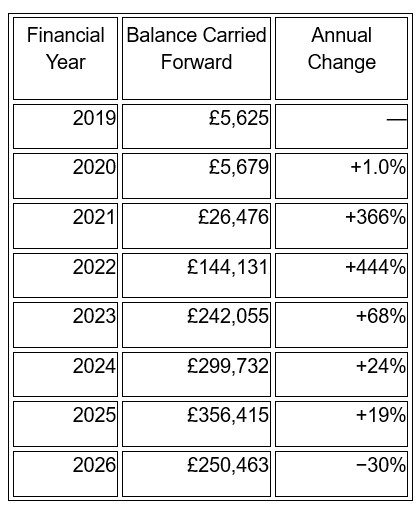
- Year-end balances increased from £5,625 (2019) to a peak of £356,415 (2025).
- This represents an increase of £350,790 (over 6,200%) in six years.
In 2026 reserves reduced by around £105,952, although they remain high compared with earlier years.
2. Other receipts became the main source of income
- Between 2022 and 2025, "Other Receipts" consistently exceeded £120,000 per year.
- These receipts were substantially larger than the annual precept and were the principal driver behind reserve growth.
3. Precept has steadily increased
- 2019: £19,944
- 2026: £51,730
- Increase of 159% over the period.
4. Staff costs remain relatively low
- Staff costs increased gradually from £2,719 to £7,846.
- They represent only a small proportion of overall expenditure.
5. Significant increase in spending during 2026
- Other payments rose to £174,915, the highest in the period.
- Combined with much lower other receipts (£32,692), this explains the reduction in reserves during 2025/26.
6. Borrowing continues to reduce
Outstanding borrowing has fallen steadily:
- 2019: £83,333
- 2026: £36,666
This indicates continuing repayment of long-term loans.
7. Asset values continue to increase
- Fixed assets increased from £426,902 to £700,561.
This reflects investment in parish infrastructure and capital assets.
Overall picture
The accounts show three distinct phases:
- 2019–2021: relatively modest reserves and stable finances.
- 2022–2025: a period of exceptionally large cash accumulation driven primarily by substantial other receipts.
- 2025–2026: reserves reduced by around 30%, suggesting that accumulated funds began to be spent on projects or capital works.
The most notable feature is the rapid growth in reserves from £5,625 to £356,415, followed by a reduction to £250,463, while Dodleston Parish Council also increased its precept and continued reducing outstanding borrowing.
Financial Analysis - key findings
The increase in the Parish Council's income largely reflects the continued growth of Kings Moat.
As additional homes have been occupied, more properties have become liable for the parish precept, increasing the Parish Council's annual income.
Community Infrastructure Levy (CIL)
Since development began at Kings Moat, Dodleston Parish Council has received several hundred thousand pounds in Community Infrastructure Levy (CIL) funding.
Published records show that a significant proportion of this funding remains unspent, with £297,487 held in reserve at the end of the 2024/25 financial year. As Kings Moat continues to grow, residents may wish to understand how these funds are prioritised and how future CIL investment could help support the community.
Based on Cheshire West and Chester Council's published Infrastructure Funding Statements, much of the Community Infrastructure Levy (CIL) received by Dodleston Parish Council has arisen from development at Kings Moat.
What is CIL?
The Community Infrastructure Levy (CIL) is a charge paid by developers to help fund infrastructure needed to support new development.
Where a parish does not have a Neighbourhood Plan (such as Dodleston), it normally receives 15% of the CIL collected from developments within the parish, subject to the statutory cap.
These funds must be spent on infrastructure or anything else that addresses the demands placed on the area by new development.
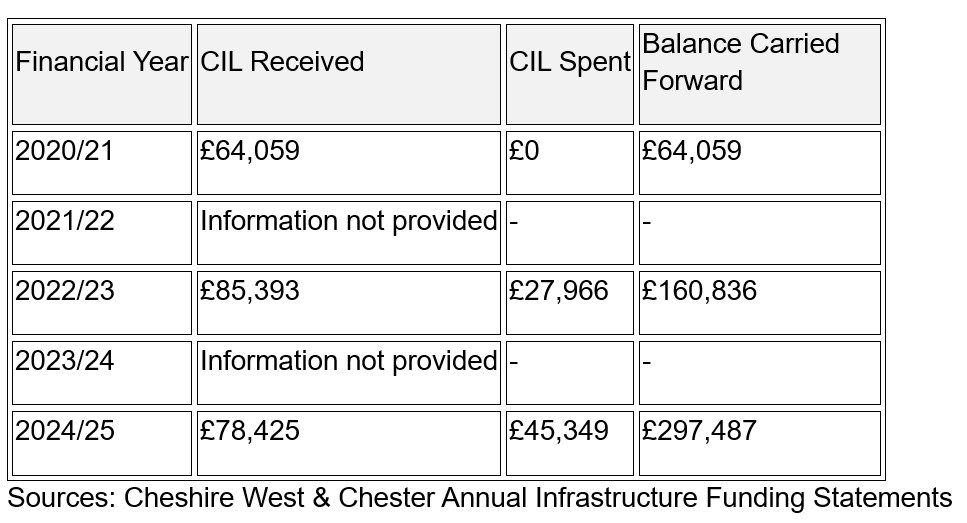
CIL received by Dodleston Parish Council:
Total known CIL received
From the published years above, Dodleston Parish Council has received at least:
- 2020/21: £64,059
- 2022/23: £85,393
- 2024/25: £78,425
- Known total: £227,877
This excludes receipts from 2021/22 and 2023/24, so the actual total received is considerably higher.
How has CIL been spent?
The Infrastructure Funding Statements identify the following projects funded during 2022/23:
- Play equipment (£18,244)
- Pavilion shed (£3,917)
- Ride-on mower (£4,500)
- Dragonfly sculpture (£1,305)
Total spent = £27,966
For 2024/25, Cheshire West and Chester records that £45,349 was spent, but notes: "Information not provided" so no breakdown of individual projects was supplied.
Current CIL reserves
As of 31 March 2025, Dodleston Parish Council held
- £297,487 of unspent CIL
This is one of the largest CIL balances held by a parish council within Cheshire West and Chester.
Why is this significant for Kings Moat?
Kings Moat is by far the largest development within Dodleston Parish and is the principal source of recent CIL income. As the development has expanded, CIL receipts by Dodlestoon Parish Council have increased substantially.
Residents often ask:
- How much CIL has Kings Moat generated?
- How has it been allocated?
- Which projects have directly benefited Kings Moat?
- What future infrastructure could these funds support?
These are reasonable questions because CIL exists specifically to help communities accommodate growth through improvements such as parks, community facilities, transport, open spaces, and other local infrastructure.